
nitotm / efficient-language-detector
Fast and accurate natural language detection. Detector written in PHP. Nito-ELD, ELD.

Fund package maintenance!
nitotm
Ko Fi
linktr.ee/nitotm
Installs: 213 024
Dependents: 4
Suggesters: 0
Security: 0
Stars: 57
Watchers: 3
Forks: 7
Open Issues: 1
pkg:composer/nitotm/efficient-language-detector
Requires
- php: ^7.4 || ^8.0
- ext-mbstring: *
README
Efficient language detector (Nito-ELD or ELD) is a fast and accurate natural language detection software, written 100% in PHP, with a speed comparable to fast C++ compiled detectors, and accuracy rivaling the best detectors to date.
It has no dependencies, easy installation, all it's needed is PHP with the mb extension.
ELD scales perfectly with database size.
ELD is also available (outdated versions) in Javascript and Python.
Installation
$ composer require nitotm/efficient-language-detector
--prefer-distwill omit tests/, misc/ & benchmark/, or use--prefer-sourceto include everything- Install
nitotm/efficient-language-detector:dev-mainto try the last unstable changes - Alternatively, download / clone the files can work just fine.
(Only small DB install under construction)
ELD execution options
- ELD has database execution Modes:
array,string,bytes,disk - ELD database Sizes:
small,medium,large,extralarge - Confused? No worries, use default with no arguments. How to use
Low memory Modes
For Modes string, bytes and disk, all size databases can run with 128MB PHP default setting
disk mode with extralarge size, can run with almost no RAM as it only uses 0.5MB
string and bytes are a great choice for general use, as they are just ~2x slower than array
Fastest Mode: Array (higher memory usage)
For array Mode it is recommended to use OPcache, specially for the larger databases to reduce load times
We need to set opcache.interned_strings_buffer, opcache.memory_consumption high enough for each database
Check Databases for more info.
How to use?
detect() expects a UTF-8 string and returns an object with a language property, containing an ISO 639-1 code (or other selected scheme), or 'und' for undetermined language.
use Nitotm\Eld\LanguageDetector;

$eld = new LanguageDetector();

$eld->detect('Hola, cómo te llamas?');
// object( language => string, scores() => array<string, float>, isReliable() => bool )
// ( language => 'es', scores() => ['es' => 0.25, 'nl' => 0.05], isReliable() => true )

$eld->detect('Hola, cómo te llamas?')->language;
// 'es'
To select database Size and Mode, or language output scheme. We can import Eld... constants to see avalible options.
use Nitotm\Eld\{LanguageDetector, EldDataFile, EldScheme, EldMode};

// LanguageDetector(databaseFile: ?string, outputFormat: ?string, mode: string)
$eld = new LanguageDetector(EldDataFile::SMALL, EldScheme::ISO639_1, EldMode::MODE_ARRAY);

// Database Size files: 'small', 'medium', 'large', 'extralarge'.
// Schemes: 'ISO639_1', 'ISO639_2T', 'ISO639_1_BCP47', 'ISO639_2T_BCP47' and 'FULL_TEXT'
// Database Modes: 'array', 'string', 'bytes', 'disk'. Check memory requirements for 'array'
// Constants are not mandatory, LanguageDetector('small'); will also work
Languages subsets
Calling langSubset() once, will set the subset.
- In
arraymode the first call takes longer as it creates a new database, if save enabled (default), it will be loaded next time we make the same subset. - In modes
string,bytes&disk, a "virtual" subset is created instantly,detect()will just remove unwanted languages before returning results. - To load a subset with 0 overhead, we can feed the returned file by
langSubset()inarraymode, when creating the instanceLanguageDetector(file)- To make use of pre-built subsets in modes
string,bytes&disk, getting lower memory usage and increased speed, it is possible by manually converting anarraydatabase, usingBlobDataBuilder()
- To make use of pre-built subsets in modes
- Check available Languages below.
// It accepts any ISO codes.
// langSubset(languages: [], save: true, encode: true); Will return subset file name if saved
$eld->langSubset(['en', 'es', 'fr', 'it', 'nl', 'de']);
// Object ( success => bool, languages => ?array, error => ?string, file => ?string )
// ( success => true, languages => ['en', 'es'...], error => NULL, file => 'small_6_mfss...' )

// to remove the subset
$eld->langSubset();

// Load pre-saved subset directly, just like a default database
$eld_subset = new Nitotm\Eld\LanguageDetector('small_6_mfss5z1t');

// Build a binary database for modes 'string', 'bytes' & 'disk', from any 'array' database
// Memory requirements for 'array' database input apply
$eldBuilder = new Nitotm\Eld\BlobDataBuilder('large'); // or subset 'small_6_mfss5z1t'
// Create subset directly: new BlobDataBuilder('extralarge', ['en', 'es', 'de', 'it']);
$eldBuilder->buildDatabase();
Other Functions
// if enableTextCleanup(True), detect() removes Urls, .com domains, emails, alphanumerical...
// Not recommended, as urls & domains contain hints of a language, which might help accuracy
$eld->enableTextCleanup(true); // Default is false

// If needed, we can get info of the ELD instance: languages, database type, etc.
$eld->info();

// Change output scheme on demand
// 'ISO639_1', 'ISO639_2T', 'ISO639_1_BCP47', 'ISO639_2T_BCP47', 'FULL_TEXT'
$eld->setOutputScheme('ISO639_2T'); // returns bool true on success
There is a CLI wrapper (BETA version)
>./bin/eld --help on Linux.
>php bin/eld --help on Windows.
Benchmarks
I compared ELD with a different variety of detectors, as there are not many in PHP.
| URL | Version | Language |
|---|---|---|
| https://github.com/nitotm/efficient-language-detector/ | 3.1.0 | PHP |
| https://github.com/pemistahl/lingua-py | 2.0.2 | Python |
| https://github.com/facebookresearch/fastText | 0.9.2 | C++ |
| https://github.com/CLD2Owners/cld2 | Aug 21, 2015 | C++ |
| https://github.com/patrickschur/language-detection | 5.3.0 | PHP |
| https://github.com/wooorm/franc | 7.2.0 | Javascript |
Benchmarks:
- Tatoeba: 20MB, short sentences from Tatoeba, 50 languages supported by all contenders, up to 10k lines each.
- For Tatoeba, I limited all detectors to the 50 languages subset, making the comparison as fair as possible.
- Also, Tatoeba is not part of ELD training dataset (nor tuning), but it is for fasttext
- ELD Test: 10MB, sentences from the 60 languages supported by ELD, 1000 lines each. Extracted from the 60GB of ELD training data.
- Sentences: 8MB, sentences from Lingua benchmark, minus unsupported languages and Yoruba which had broken characters.
- Word pairs 1.5MB, and Single words 870KB, also from Lingua, same 53 languages.
Time execution benchmark for ELD size large ( check others sizes at more benchmarks )
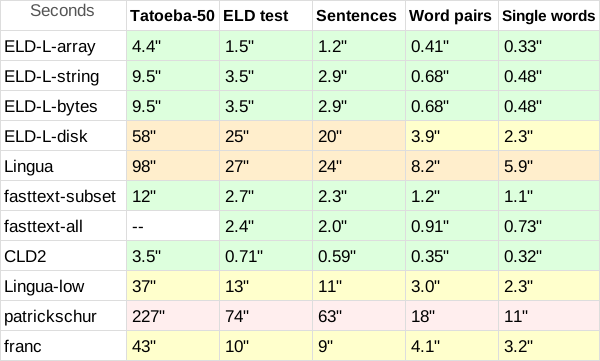
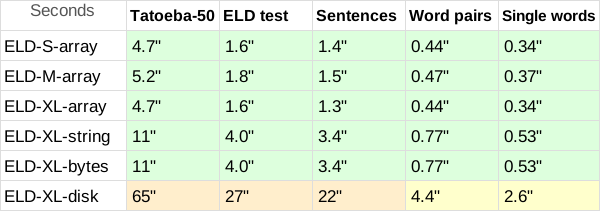
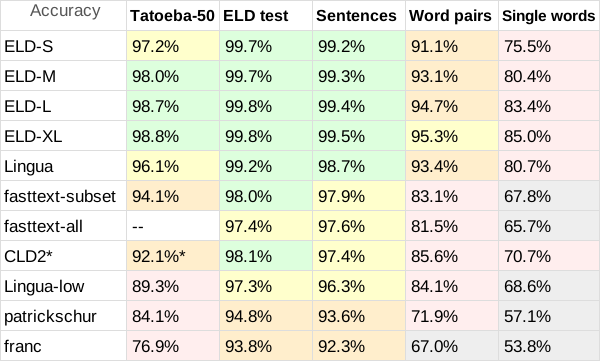
- Lingua participates with 54 languages, Franc with 58, patrickschur with 54.
- fasttext does not have a built-in subset option, so to show its accuracy and speed potential I made two benchmarks, fasttext-all not being limited by any subset at any test
- * Google's CLD2 also lacks subset option, and it's difficult to make a subset even with its option
bestEffort = True, as usually returns only one language, so it has a comparative disadvantage. - Time is normalized: (total lines * time) / processed lines
Databases
Low memory database modes
Modes 'bytes' and 'string' are very similar, they differ on how they are load, and are just 2x slower than Array
Mode 'string' can be OPcache'd, more expensive compilation, but then instant load, 'bytes' has always a steady ~fast load
Special mention to 'disk' mode, while slower, is the fastest uncached load & detect for the larger databases
| Mode | Disk | Bytes | String | Bytes | String |
|---|---|---|---|---|---|
| Database Size option | Extralarge | Extralarge | Extralarge | Large | Large |
| File size | 39 MB | 39 MB | 39 MB | 20 MB | 20 MB |
| Memory usage | 0.4 MB | 40 MB | 40 MB | 22 MB | 22 MB |
| Memory usage Cached | 0.4 MB | 40 MB | 0.4 MB + OP | 22 MB | 0.4 MB + OP |
| Memory peak | 0.4 MB | 40 MB | 56 MB | 22 MB | 32 MB |
| Memory peak Cached | 0.4 MB | 40 MB | 0.4 MB + OP | 22 MB | 0.4 MB + OP |
| OPcache used memory | - | - | 39 MB | - | 20 MB |
| OPcache used interned | - | - | 0.4 MB | - | 0.4 MB |
| Load & detect() Uncached | 0.0012 sec | 0.04 sec | 0.25 sec | 0.02 sec | 0.11 sec |
| Load & detect() Cached | 0.0011 sec | 0.04 sec | 0.0003 sec | 0.02 sec | 0.0003 sec |
| Mode | Bytes | String | Bytes | String |
|---|---|---|---|---|
| Database Size option | Medium | Medium | Small | Small |
| File size | 6 MB | 6 MB | 2 MB | 2 MB |
| Memory usage | 8 MB | 8 MB | 2 MB | 2 MB |
| Memory usage Cached | 8 MB | 0.4 MB + OP | 2 MB | 0.4 MB + OP |
| Memory peak | 8 MB | 12 MB | 2 MB | 3 MB |
| Memory peak Cached | 8 MB | 0.4 MB + OP | 2 MB | 0.4 MB + OP |
| OPcache used memory | - | 0 MB | - | 0 MB |
| OPcache used interned | - | 6 MB | - | 2 MB |
| Load & detect() Uncached | 0.006 sec | 0.04 sec | 0.003 sec | 0.016 sec |
| Load & detect() Cached | 0.006 sec | 0.0003 sec | 0.002 sec | 0.0003 sec |
Fastest mode Array, but memory hungry
| Array Mode, Size: | Small | Medium | Large | Extralarge |
|---|---|---|---|---|
| Pros | Lowest memory | Equilibrated | Fastest | Most accurate |
| Cons | Least accurate | Slowest (but fast) | High memory | Highest memory |
| File size | 3 MB | 9 MB | 28 MB | 64 MB |
| Memory usage | 46 MB | 137 MB | 547 MB | 1143 MB |
| Memory usage Cached | 0.4 MB + OP | 0.4 MB + OP | 0.4 MB + OP | 0.4 MB + OP |
| Memory peak | 78 MB | 287 MB | 969 MB | 2047 MB |
| Memory peak Cached | 0.4 MB + OP | 0.4 MB + OP | 0.4 MB + OP | 0.4 MB + OP |
| OPcache used memory | 21 MB | 70 MB | 242 MB | 516 MB |
| OPcache used interned | 4 MB | 10 MB | 45 MB | 91 MB |
| Load & detect() Uncached | 0.13 sec | 0.5 sec | 1.4 sec | 3.2 sec |
| Load & detect() Cached | 0.0003 sec | 0.0003 sec | 0.0003 sec | 0.0003 sec |
| Settings (Recommended) | ||||
memory_limit |
>= 128 | >= 340 | >= 1060 | >= 2200 |
opcache.interned...* |
>= 8 (16) | >= 16 (32) | >= 60 (70) | >= 116 (128) |
opcache.memory |
>= 64 (128) | >= 128 (230) | >= 360 (450) | >= 750 (820) |
- * I recommend using more than enough
interned_strings_bufferas buffers overflow error might delay server response.
To use all databasesopcache.interned_strings_buffershould be a minimum of 160MB (170MB). - When choosing the amount of memory keep in mind
opcache.memory_consumptionincludesopcache.interned_strings_buffer.- If OPcache memory is 230MB, interned_strings is 32MB, and medium DB is 69MB cached, we have a total of (230 -32 -69) = 129MB of OPcache for everything else.
- Also, if you are going to use a subset of languages in addition to the main database, or multiple subsets, increase
opcache.memoryaccordingly if you want them to be loaded instantly. To cache all default databases comfortably you would want to set it at 1200MB.
Testing
Default composer install might not include these files. Use --prefer-source to include them.
- For dev environment with composer "autoload-dev" (root only), the following will execute the tests
new Nitotm\Eld\Tests\TestsAutoload();
- Or, you can also run the tests executing the following file:
$ php efficient-language-detector/tests/tests.php # Update path
- To run the accuracy benchmarks run the
benchmark/bench.phpfile.
Languages
- These are the ISO 639-1 codes that include the 60 languages. Plus
'und'for undetermined
It is the default ELD language scheme.outputScheme: 'ISO639_1'
am, ar, az, be, bg, bn, ca, cs, da, de, el, en, es, et, eu, fa, fi, fr, gu, he, hi, hr, hu, hy, is, it, ja, ka, kn, ko, ku, lo, lt, lv, ml, mr, ms, nl, no, or, pa, pl, pt, ro, ru, sk, sl, sq, sr, sv, ta, te, th, tl, tr, uk, ur, vi, yo, zh
- These are the 60 supported languages for Nito-ELD.
outputScheme: 'FULL_TEXT'
Amharic, Arabic, Azerbaijani (Latin), Belarusian, Bulgarian, Bengali, Catalan, Czech, Danish, German, Greek, English, Spanish, Estonian, Basque, Persian, Finnish, French, Gujarati, Hebrew, Hindi, Croatian, Hungarian, Armenian, Icelandic, Italian, Japanese, Georgian, Kannada, Korean, Kurdish (Arabic), Lao, Lithuanian, Latvian, Malayalam, Marathi, Malay (Latin), Dutch, Norwegian, Oriya, Punjabi, Polish, Portuguese, Romanian, Russian, Slovak, Slovene, Albanian, Serbian (Cyrillic), Swedish, Tamil, Telugu, Thai, Tagalog, Turkish, Ukrainian, Urdu, Vietnamese, Yoruba, Chinese
- ISO 639-1 codes with IETF BCP 47 script name tag.
outputScheme: 'ISO639_1_BCP47'
am, ar, az-Latn, be, bg, bn, ca, cs, da, de, el, en, es, et, eu, fa, fi, fr, gu, he, hi, hr, hu, hy, is, it, ja, ka, kn, ko, ku-Arab, lo, lt, lv, ml, mr, ms-Latn, nl, no, or, pa, pl, pt, ro, ru, sk, sl, sq, sr-Cyrl, sv, ta, te, th, tl, tr, uk, ur, vi, yo, zh
- ISO 639-2/T codes (which are also valid 639-3)
outputScheme: 'ISO639_2T'. Also available with BCP 47ISO639_2T_BCP47
amh, ara, aze, bel, bul, ben, cat, ces, dan, deu, ell, eng, spa, est, eus, fas, fin, fra, guj, heb, hin, hrv, hun, hye, isl, ita, jpn, kat, kan, kor, kur, lao, lit, lav, mal, mar, msa, nld, nor, ori, pan, pol, por, ron, rus, slk, slv, sqi, srp, swe, tam, tel, tha, tgl, tur, ukr, urd, vie, yor, zho
Donations and suggestions
If you wish to donate for open source improvements, hire me for private modifications, request alternative dataset training, or contact me, please use the following link: https://linktr.ee/nitotm